Can You Use Niacinamide Skincare With Vitamin C?
It’s time to debunk common skincare myths and misconceptions, this time about confusing claims online about two of our favourite skincare ingredients: Niacinamide and Vitamin C. Both ingredients have been popular in skincare for a while but have come to dominate the 2022 skincare ingredient trends.
However, several blogs and even some beauty magazine articles state that while the two ingredients are great on their own, combining them creates a two-fold problem: One, it neutralises the effectiveness of both ingredients, and two, it might create a substance (nicotinic acid) that leads to skin redness.
Here’s why you can breathe a sigh of relief: Research has shown that combining Niacinamide and Vitamin C does not lead to skin problems; in fact, the combination can lead to a wealth of skin benefits.
The Truth about Niacinamide Skincare and Vitamin C
The idea that Niacinamide and Vitamin C can’t be combined is based on outdated research that was interpreted incorrectly. Here at Paula’s Choice Skincare Singapore, all our products and advice are research-based. We examine all research with a critical eye to see how it applies to the information we share and the ingredients we use in our skincare products. Here’s where we’re going to get science-y, but hang in there because your skin will love the results!
The studies showing incompatibility between Niacinamide and Vitamin C date back to the early 1960s (yes, that far). These studies were off from the start because they used non-stabilised forms of both ingredients, whereas both are typically stabilised in modern-day cosmetics formulas.
Niacinamide is a pretty “tough” ingredient; light and air don’t have the same effect on it as they do on antioxidants like Vitamin C. What’s important for Niacinamide is that the product is formulated at a pH that’s close to neutral. Vitamin C (pure ascorbic acid), on the other hand, does best in a low-pH (acidic) environment.
However, nicotinic acid — the undesirable by-product of Niacinamide and Vitamin C — becomes an issue only when Niacinamide and Vitamin C are combined in a high-temperature environment for a long time. That temperature is much higher than you’d encounter in most at-home scenarios, including leaving a box of skincare products sitting outside in the sun for a couple of days.
Also, it’s important to point out that this concern applies only to pure Vitamin C, not to its many other forms (such as magnesium ascorbyl phosphate, tetrahexyldecyl ascorbate, and ascorbyl glucoside).
To reiterate, combining pure Vitamin C, AKA ascorbic or l-ascorbic acid, with Niacinamide is fine as the circumstances that produce nicotinic acid do not apply to everyday applications of these powerhouse ingredients.
In short, any studies that show a definite issue with combining Niacinamide and Vitamin C were conducted in conditions that do not reflect what average skincare products experience during development, manufacturing, or in real-world storage and usage.
Can You Mix Niacinamide Skincare Products with Vitamin C?
Research shows that you’re safe to use both Niacinamide and Vitamin C together on your skin, either together in the same skincare product, or combined from different products that you layer one over the other.
Benefits of Using Niacinamide Skincare Products and Vitamin C Together
The benefits from such a mix are numerous!
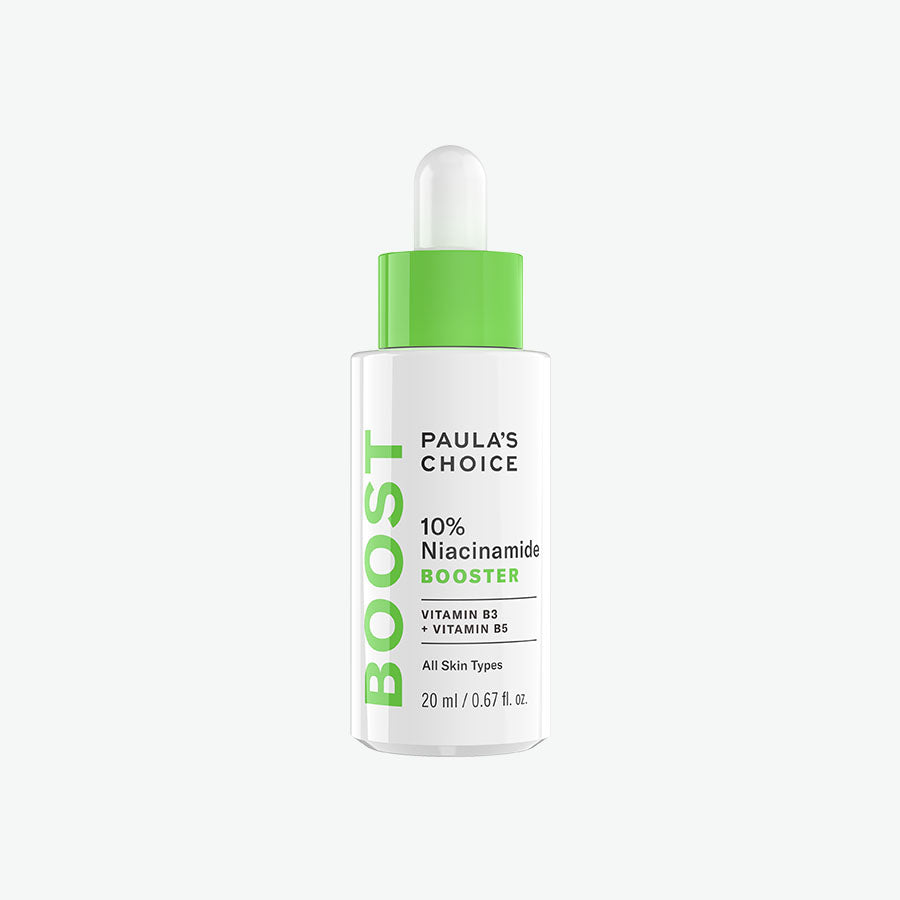
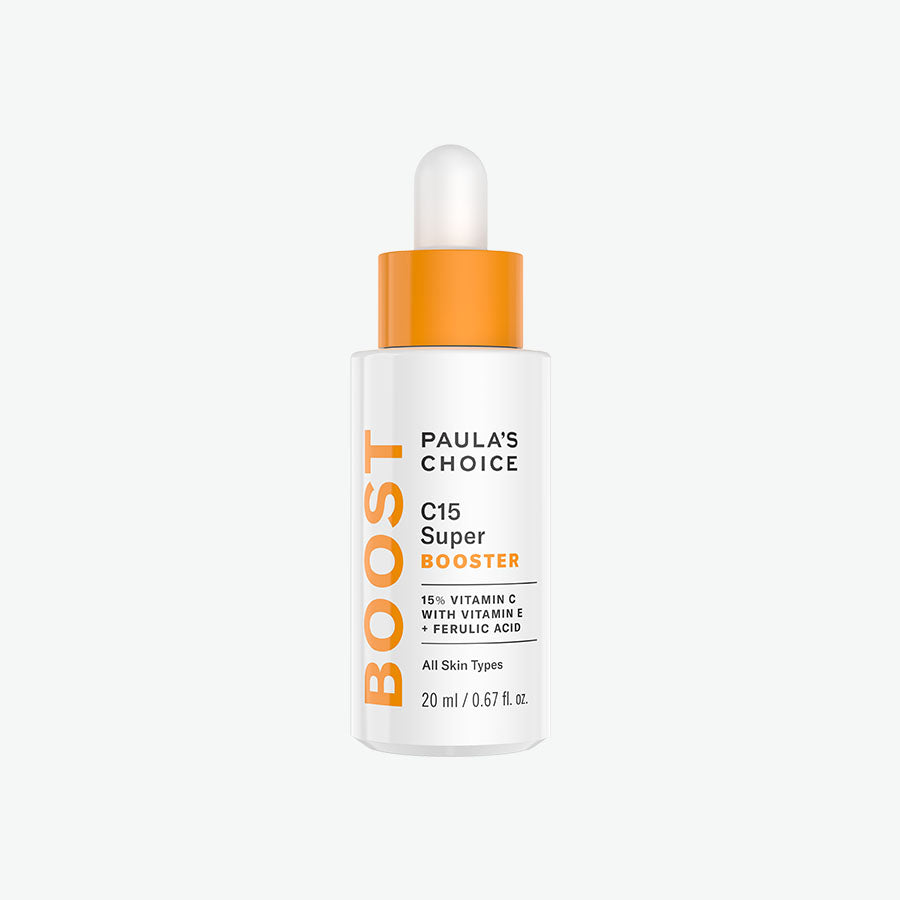
On its own, like in our BOOST 10% Niacinamide Booster, Niacinamide is a skin-restoring ingredient that can visibly improve the appearance of enlarged pores, fine lines, and skin dullness. Find out just how our Niacinamide booster works and how you can incorporate it into your skincare routine. Meanwhile, Vitamin C, like in our BOOST C15 Super Booster, is a potent antioxidant that helps defend skin from the visible impact of environmental stressors such as free radicals, plus it's a dullness-diminishing agent that can improve the visible signs of aging.
Together, these ingredients form a powerhouse combo that addresses uneven skin tone, wrinkles, loss of firmness, and dullness. All skin types will see a complexion that progressively becomes more radiant, smoother, more even, and noticeably younger-looking.
One more point: We know, from reams of research, how Niacinamide benefits skin. But did you know that Vitamin C (ascorbic acid) is the most abundant antioxidant that occurs naturally in skin? It’s true! Given this fact, if Vitamin C and Niacinamide weren’t compatible, topical use of Niacinamide would either do nothing or result in skin problems — and today’s studies are showing only benefits.
We invite you to try this combination for yourself. You might find you’ll become a true believer — no myths, just facts and results.
Learn more about skincare tips and how to tackle common skin concerns on our advice page.
Shop Niacinamide moisturizers, serums, creams, and more at Paula’s Choice Skincare Singapore.
References for This Information
- Jiang, N., Quan, T., Li, R., Chen, Y., & Gao, T. (2025). Role of Nutritional elements in skin homeostasis: a review. Biomolecules, 15(6), 808. https://doi.org/10.3390/biom15060808
- Jaros-Sajda, A., Budzisz, E., & Erkiert-Polguj, A. (2024). Ascorbic acid treatments as effective and Safe Anti-Aging therapies for sensitive skin. Antioxidants, 13(2), 174. https://doi.org/10.3390/antiox13020174
- Correia, G., & Magina, S. (2023). Efficacy of topical Vitamin C in melasma and photoaging: A systematic review. Journal of Cosmetic Dermatology, 22(7), 1938–1945. https://doi.org/10.1111/jocd.15748
- Marques, C., Hadjab, F., Porcello, A., Lourenço, K., Scaletta, C., Abdel-Sayed, P., Hirt-Burri, N., Applegate, L. A., & Laurent, A. (2024). Mechanistic Insights into the Multiple Functions of Niacinamide: Therapeutic Implications and Cosmeceutical Applications in Functional Skincare Products. Antioxidants, 13(4), 425. https://doi.org/10.3390/antiox13040425
- Abric, E., Mathias, J., Tardieu, A., Mateos, L., Eeckhout, C., Drulhon, F., & Ardiet, N. (2024). Anti-Spot, lightening effect and cutaneous acceptability of a stable anhydrous ecobiological formulation of 10% L-Ascorbic acid. Clinical Cosmetic and Investigational Dermatology, Volume 17, 489–491. https://doi.org/10.2147/ccid.s443182
- Park, H. J., Byun, K., Oh, S., Kim, H. M., Chung, M. S., Son, K. H., & Byun, K. (2022). The combination of Niacinamide, Vitamin C, and PDRN mitigates melanogenesis by modulating nicotinamide nucleotide transhydrogenase. Molecules, 27(15), 4923. https://doi.org/10.3390/molecules27154923